Henrik Carlsson's Blog

All things me.

Cyberpunk

posted this note on and tagged it with Blade Runner Books Cyberpunk Neuromancer Reading The Matrix William Gibson

My most recent listen, after The Sandman: Act III, is William Gibson’s ”Neuromancer”. It’s a novel that I’ve read a couple of times before, but that before is now the distant past. It’s definitely an important part of my science fiction origin story, and something that I’ve liked a whole lot because I’ve wanted to like it a whole lot. See also ”Blade Runner”.

Back in the mid nineties, probably ’94, I first watched ”Star Wars” and fell in love with it. Prior to that, and after that, I read and enjoyed a lot of science fictions stories. It also furthered me deeper into the sci-fi black hole. The first and most prominent stop in that hole was ”Blade Runner”. Here was a movie starring Harrison Ford, about a future cop chasing humanoid robots, in a hauntingly beautiful and disturbing dystopia. Obviously I was going to love it, right.

Right.

Right?

I think the fact that Blade Runner stared Ford did a lot of heavy lifting for me when I first watched it, probably as a twelve year old. I most certainly didn’t understand it, and the fact that what I watched was a VHS copy on a 19″ television screen meant that I could not fully appreciate it’s cinematic beauty. But I did convince myself that I liked it, and it’s a movie that I’ve returned to over and over again. It has grown with me and as an adult I absolutely think that it is a masterpiece.

What does this have to do with Neuromancer? Well, everything. Partly because they are both defining works within cyberpunk, partly because cyberpunk as a whole was one of those things that I knew that I wanted to like, so I made myself like, even though it was weird thing for pre teen me. I am so far removed from the standard cyberpunk protagonist, and I’ve never really been part of the goth, punk or any other subculture that’s close to cyberpunk. I was a squeaky clean, middle-manager type even as an elven year old.

Anyway, some way along the line I picked up on cyberpunk being a thing, and that William Gibson was important within that genre. The exact timeline is hazy, thirty years later, but it’s undeniable that the next Big Thing in this story happened in 1999 when I watched ”The Matrix”. No movie have ever before, not ever after, had a bigger impact on me.1 I was fourteen years old and I felt like I could suddenly see the world in a new light. Sure, the kung fu fights and the tight leather outfits was a part of the appeal, but the philosophy, the ideas also struck a chord big time. Even though it wasn’t a true description of the world, it was still accurate.

And as I geeky out to The Matrix, thought more about it, and read more about it, cyberpunk kept coming up. Again, the exact timeline is blurry. I had probably read a novel or two from William Gibson, but I’m almost positive that I read Neuromancer, in a Swedish translation, after watching The Matrix. After that, I read Count Zero and Mona-Lisa Overdrive as well.

Neuromancer was similar to Blade Runner to me, in that I probably wanted to like it more that I did. I absolutely wanted to understand it more that I did. But I did like it, and it felt profound. I re-read it. I read more Gibson, slowly but surely.

Now, as I listen to it as a forty year old, I think I fully appreciate it for the first time. It is really, truly a masterpice.


  1. The only close contenders is probably Star Wars, and Stand By Me. 
posted this note on and tagged it with Books Neil Gaiman Reading Sandman

After finishing ”Rita Hayworth and Shawshank Redemption” I sort of ”lost the plot” on audiobooks for a while again. That meant a lot of podcasts for a few weeks but then I got into the audio drama version of Neil Gaiman’s The Sandman: Act III. I’ve listened to ”Act I” and ”Act II” in the past and liked them both. I’ve also read various parts of ”The Sandman” comic at various times and liked them. I also watched the first season of the Netflix adaptation (is there more seasons?) and found it decent, but nothing more.

For the past year or so, Gaiman has been accused of being, let’s say, a less than fantastic person. It’s hard to not think about that when reading/listening to his works, but I always try to not let that stop me from enjoying a work of art. If a person has committed a crime they should be punished for it, regardless of whether they are ”artists” or not. However, in my opinion, a piece of art could still, and should still, be enjoyed even if one or more of the artists behind it is a piece of shit.1

That being said, it’s hard to listen to various parts of ”The Sandman” with the recent accusations in mind and not think that it is probably the work of someone who is somewhat fucked up.

So did I enjoy it? Yes, most of it, but not all of it.


  1. Sidenote: I’m also a firm believer in ”innocent until proven guilty in a court of law”. 

Replies and comments

posted this note on

Nighttime, just days after Midsummer Nights Eve. I’m sitting on the backyard deck, an old fashioned next to me and my hand on my computer keyboard. This is probably my absolute favorite part of the year.

Rita Hayworth and Shawshank Redemption

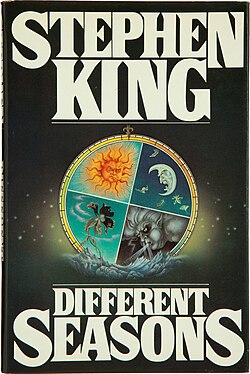
posted this note on and tagged it with Books Different Seasons Reading Rita Hayworth and Shawshank Redemption Stephen King

I just finished Rita Hayworth and Shawshank Redemption and now I’m holding back tears and I need to write something down immediately.

I consider myself a fan of Stephen King. I want to say that came to King quite recently, all though when I looked up that post I realized that it’s eight years old this year so maybe ”recently” is a relative term. Anyway, for those eight years I’ve read quite a few of his novels and a couple of his short-stories and I pretty much love them all. Rita Hayworth and Shawshank Redemption is probably my all time favorite, thus far.

Unsurprisingly I’ve watched the film version quite a few times and I love it. Part of the magic of listening to this novella now is in my memories of the movie. Even though it is narrated by the wonderful Frank Mueller, some times I hear Red’s words in Morgan Freeman’s voice. I also see Freeman and Tim Robbinson in my mind’s eye.

But mostly the magic i King’s writing, and his impeccable ability to have empathy for his characters, and to make us readers feel for them. Red is by no means a saint. In fact, he is indeed a murderer. If we disconnect him from the story, and from Freeman’s portrait of him, we all agree that he should be behind bars. But I don’t thing anybody can read the novella, or watch the movie, and believe that he is not worthy of redemption, and of hope.

This feels very topical today, when there is an election year here in Sweden and much of the past for years, both from the current government and from the opposition, has been about being
tougher on crime, on locking people up for longer times, on making it easier to lock people up. I honestly think every single politician should read this novella this year, to at least have some empathy.

posted this note on and tagged it with Books Different Seasons Reading Rita Hayworth and Shawshank Redemption Stephen King

After finishing 2001 yesterday, I needed to start a new audiobook on my commute. I didn’t want to spend to much time choosing so I scrolled through the downloaded books on Prologue and ended up glancing on Stephen King’s Different Seasons, so I started Rita Hayworth and Shawshank Redemption.

I’ve watched the film version multiple times, but I’ve never read the ”short story” before. It hooked me right away so I’m already an hour and a halt into it.

posted this note on and tagged it with 2001 A Space Odyssey Arthur C Clarke Books Reading

Yesterday evening, after blogging about reading it, I finished 2001: A Space Odyssey and I really, really liked it. From what I’ve understood it has gotten some (maybe even a lot of) critique over the years for spelling things out in the ending part, rather than being artfully vague like Kubrick’s film. Personally, I prefer the spelled out version.

Keep in mind, it’s been at least ten years since the one and only time that I watched the movie so I’m working from old memories here. However, I do remember not ”getting it” in the end. Now, it’s perfectly fine to make a movie that not everybody ”gets”. It’s even okay to make a movie that you are not supposed to get.1 But 2001 seems like a movie that has a clear narrative, but then decides to make the ending abstract even though nothing up until that point has been like that.

By contrast, by spelling things out the book can focus on the ideas and present them in a clear way.


  1. David Lynch’s approach to movie-making comes to mind. Like Mullholland Drive

Replies and comments

posted this note on and tagged it with 2001 A Space Odyssey Books Reading The End of the World as We Know It

After bailing on Frank Herbert’s Dune I’ve dipped in and out of a few books. First, I gave ”Zen and the Art of Motorcycle Maintenance” a go. Maybe it’s the audiobook’s fault, maybe it’s mine but I just couldn’t stand it for more than fifteen minutes. So instead I jumped into The End of the World as We Know It: New Tales of Stephen King’s The Stand, an anthology telling stories about the world of Stephen King’s The Stand. This was much more my cup of tea, but about half (maybe) into the third short-story I lost steam and I took a break. That break has lasted for a month or so now.

A week or so ago I started Arthus C. Clarke’s 2001: A Space Odyssey. Now this is absolutely my cup of tea! I watched Kubrick’s movie many years ago and it is a classic for a reason. That being said, I think I’m one of the weird people who like the novel better.1 The story is fascinating even though I know where it will all end up. It’s got just the right amount of details to keep the nerd inside me interesting, while not getting bogged down in endless regressions on orbital mechanics2. It also feels quite relevant again as our interest in space travel are increasing again, at the same time as the current fixation on AI.

The format of the audiobook also fits my life perfect right now. A single chapter is never longer than fifteen minutes, which happens to be the length of my commute to work. When they’re significantly shorter than that, two usually adds upp to no more than fifteen as well making it perfect for listening to while driving to work.


  1. Thereby making Kubrick movies and their novels a two for two in favor of the novels for me 
  2. I love your writing, Neal Stephenson, but if I’m not in the right mood your books can be a bit tedious. 

Replies and comments

posted this note on

The first hour long meeting today only needed twenty minutes, and resulted in us being able to cancel the second hour long meeting of the day, and and we could also cancel the two hour meeting scheduled for tomorrow.

The working day couldn’t possibly go any better than this. :)

Progress update on the IKEA TRÅDFRI to Home Assistant migration

posted this note on and tagged it with Home Assistant Smart Home

The smart home migration project is going along fairly smoothly. I spent most of Saturday on it (today’s Tuesday) and then I’ve kept fixing smaller things along the way.

The physical challenge of resetting and re-pairing the LED drivers ended up being less challenging then I expected. The shelves were easier to move and the drivers less tucked away than I thought. Instead what proved to be the hardest part was getting the FLOALT ceiling panels to disconnect from the Ikea gateway and connect to Home Assistant. After many superstitious rituals I think I’ve landed on the problem and solution. The Ikea gateway was ”taking them back” as soon as I reste them, so once I disconnected the power to the gateway before resetting the panels, it worked fine.

So now all my lamps, outlets, LED drivers and buttons are moved to Home Assistant. I do however have a lot of work left to do in Home Assistant. Currently there are way too few scenes and automations, most of the buttons are not setup to do anything and too many daily operations1 requires us to use the phone app to turn on and off lights.

Primarily I need to look into the remotes, particularly the simpler on/off buttons. In one case it and a LED driver is paired together and the button controls the driver, even thought as far as I know I haven’t setup anything in Home Assistant. I assume there is some sort of way to tell a device that it should be controlled by a button and that on, off, dimm up, dimm down, etc. will just work.


  1. The only acceptable number here is 0
posted this note on

Also, I found a simple video tutorial in Swedish1 to get started with TRÅDFRI stuff on Home Assistant.


  1. Well, skånska